How Many Photos Does an Average Wedding Have? (2026 Breakdown)
A typical wedding produces 400–800 professionally edited photos plus roughly 100 to 350 guest candids when a QR code system is used, about 500 to 1,150 images total. Here's exactly how those numbers break down by guest count, photography style, and time of day.

Quick Answer
The average wedding produces 400–800 professionally edited photos from the photographer, plus roughly 100 to 350 guest photos when couples use a QR code collection system, about 500 to 1,150 images total. Without a guest photo system, couples typically receive only 10–150 candids from guests alongside their professional gallery.
How many photos does an average wedding have? Quick answer
A typical wedding produces 400–800 professionally edited photos from the photographer and an additional 100 to 350 guest photos when couples use a photo-sharing QR code, for a combined total of roughly 500 to 1,150 images. Without a system to collect guest photos, couples receive only their professional gallery.
| Photo source | Typical count |
|---|---|
| Professional photographer (delivered, edited) | 400–800 |
| Guests — with QR code collection system | 100–350 |
| Guests — no system (email / WhatsApp requests) | 10–150 |
| Total with QR code | 900–2,000 |
| Total without a guest system | 410–950 |
The professional gallery is consistent regardless of what you do on the day. The guest photo count is almost entirely determined by whether you have a frictionless collection method in place.
How many photos does a wedding photographer take vs deliver?
Most wedding photographers shoot 2,000–4,000 RAW images over a full 8–10 hour wedding day. They deliver 400–800 fully edited JPEGs — roughly 40–60 photos per hour of coverage. The gap between shots taken and photos delivered is intentional: photographers cull duplicate angles, out-of-focus frames, and transitional shots. What you receive is a curated selection, not a raw archive.
| Coverage length | RAW shots taken | Delivered (edited) |
|---|---|---|
| 4 hours (ceremony only) | 600–1,000 | 150–300 |
| 6 hours | 1,200–2,000 | 280–450 |
| 8 hours (full day) | 2,000–3,200 | 400–650 |
| 10 hours | 2,500–4,000 | 500–800 |
| Two photographers (8 hours) | 4,000–6,000 | 700–1,200 |
Most photographers deliver within 4–8 weeks. Destination wedding photographers often take 8–12 weeks due to higher volume and travel editing time.
Guest photos: the other half of the story
Professional photographers cover the planned moments — portraits, family formals, the first dance, the cake cutting. What they miss, by definition, is everything happening simultaneously in the other 80% of the room. Guests at a 100-person wedding collectively take 2,000–5,000 photos throughout the day. The question is whether any of those reach the couple.
Without a collection system:
- Email after the wedding: ~12 photos on average — people mean well but forget or find it too cumbersome
- WhatsApp group: 150–200 photos, all compressed by 70% and unusable for printing
- Instagram hashtag: 50–100 photos, public-only, excludes non-Instagram users (typically everyone over 60)
With a QR code collection system (paid weddings on Snapeen, summer 2026):
- Median gallery: 99 guest photos; top 10% above 275; the record is 349
- Contributing guests send 12.6 photos each on average
- 8 in 10 guests who start an upload finish it
- About 1 in 4 uploads arrives from a computer, usually the day after
Wedding photo count by guest size
Guest count is a factor, but placement strategy matters more than headcount. These averages are from Snapeen events where QR codes were placed at 4+ locations:
| Guest count | Professional estimate | Guest photos (QR code) | Total estimate |
|---|---|---|---|
| Under 30 guests | 200–350 | 150–400 | 350–750 |
| 30–75 guests | 300–500 | 350–700 | 650–1,200 |
| 75–150 guests | 400–700 | 500–1,000 | 900–1,700 |
| 150–250 guests | 500–800 | 700–1,400 | 1,200–2,200 |
| 250+ guests | 600–1,200 | 900–1,800 | 1,500–3,000 |
Destination weddings consistently run 20–30% above these figures because guests travel more deliberately, bring better camera equipment, and are fully present without work distractions.
Wedding photos by time of day
A full-day wedding is not photographed evenly — some phases produce far more images than others. Based on typical 8-hour coverage:
| Phase | Duration | Approx professional photos |
|---|---|---|
| Getting ready (bridal suite) | 1.5–2 hrs | 80–150 |
| First look + couple portraits | 30–45 min | 60–120 |
| Ceremony | 20–45 min | 80–180 |
| Cocktail hour / mingling | 1 hr | 60–100 |
| Reception entrance + first dances | 30 min | 40–80 |
| Dinner + speeches | 1–1.5 hrs | 60–120 |
| Dancing | 1.5–2 hrs | 80–160 |
| Cake cutting + details | 30 min | 40–80 |
The ceremony and dancing phases generate the highest photos-per-hour. The cocktail hour and dinner phases are where guest uploads concentrate — guests are seated and relaxed, phones naturally in hand.
How photography style affects your delivery count
Not all photographers deliver the same volume. Style matters as much as coverage length:
| Style | Typical delivered count | Characteristics |
|---|---|---|
| Traditional / posed | 350–550 | Fewer shots per setup; carefully composed groups and portraits |
| Documentary / photojournalist | 500–800 | High-volume capture of candid, unposed moments throughout |
| Fine art | 300–500 | Selective, heavily edited, slower shooting pace |
| Two photographers | 700–1,200 | Simultaneous coverage of multiple locations and perspectives |
Ask your photographer at the booking stage: "Roughly how many edited photos do you typically deliver for an 8-hour wedding?" Any answer under 350 for a full day is on the low end; anything over 800 is very generous. Get it in writing in the contract.
Why professional photos alone aren't the complete record
Your photographer covers the focal points of the day. At a 150-person reception, that means one person covering a room of 150 — they capture the toasts, but not the reaction at every table simultaneously. Guest photos fill the blind spots:
- Reaction shots taken from multiple angles across the room at the same moment
- Candids from the bridal suite shot by bridesmaids or family while the photographer is outside
- Arrival photos from guests catching up before the ceremony starts
- Late-night dance floor shots from people in the middle of the crowd, not on the periphery
- Moments between guests that have nothing to do with the couple but tell the story of the whole day
In Snapeen's survey of couples after their weddings, the most common description of guest photos was "the other half of the story" — not substitutes for professional images, but a completely different kind of record that no single photographer could produce.
How to maximize your total wedding photo count
Professional photos:
- Book for full-day coverage (8+ hours) if budget allows — the best light and most candid moments happen in the first and last two hours
- Consider a second photographer for ceremonies with 100+ guests or venues with multiple simultaneous locations
- Discuss deliverable count upfront and include the expected range in the contract
Guest photos:
- Set up a QR code collection system — Snapeen setup takes under 10 minutes and the free plan is $0
- Place the QR code at 4+ locations: every table card, the bar, entrance signage, and inside programs
- Ask the DJ to announce it at dinner, before the first dance, and near the end of the night
- Enable the live slideshow feature — watching their photos appear on screen motivates guests to upload more
The combined approach: The highest-performing weddings combine professional photography with a guest QR code system. The professional photographer delivers the edited, curated narrative. The guest photos deliver the candid, multi-angle archive that no single photographer could produce. Together they create a record of the day that neither source could create alone.
What to do with 900+ wedding photos
Getting more photos creates a curation challenge most couples don't anticipate. A practical framework:
Days 1–7: Download everything immediately. Back up to at least two locations (external drive + cloud service). Don't wait until week 3 — storage windows close and life gets busy after the honeymoon.
Weeks 1–3: Do a quick pass through the guest photos — delete obvious duplicates and blurry shots. Aim for "good enough" rather than perfect curation. The goal is a manageable archive, not a curated gallery.
Month 1–3: Choose 50–100 images for an album. Most album services (Artifact Uprising, Chatbooks, Artifact) will suggest a selection automatically based on image quality scoring.
Long-term: Share the full gallery link with both families. Parents and siblings frequently want access to every shot, even the imperfect ones. The guest photo collection in particular — unedited, honest, multi-perspective — is often what grandparents treasure most.
See also: The Snapeen Wedding Photo Report 2026 · QR code for wedding photos — complete setup guide · Wedding photography statistics 2026 · Best wedding photo apps 2026
Frequently Asked Questions
Most wedding photographers shoot 2,000–4,000 RAW images during an 8-hour wedding day and deliver 400–800 edited JPEGs — roughly 40–60 photos per hour of coverage. Two photographers covering the same wedding typically deliver 700–1,200 edited photos.
Without a collection system, couples typically receive 10–150 guest photos via email, WhatsApp, or hashtag requests. With a QR code collection system like Snapeen, a paid wedding gallery typically ends up with 100 to 350 guest photos; the median in summer 2026 was 99 and the record 349.
Couples who use a QR code guest photo system alongside a professional photographer typically receive 500 to 1,150 photos total: 400–800 professionally edited images plus 100 to 350 guest uploads. Without a guest collection system, the total typically stays at 410–950 (mostly the professional gallery).
Guest count is a factor, but placement strategy matters more. Couples who place the QR code at 4+ locations and have the DJ announce it collect far more guest photos than those with a single placement point, regardless of guest count. A well-placed system at a 75-person wedding can outperform a poorly-placed one at a 200-person wedding.
Most wedding photographers deliver approximately 40–60 edited photos per hour of coverage. For a full 8-hour wedding day, that translates to 400–650 photos. Photographers who shoot in a documentary style tend toward the higher end (50–60/hour); traditional and fine art photographers tend toward the lower end (35–45/hour).
Topics

Written by
Sarah Johnson
Helping couples and event planners capture every precious moment with modern QR code photo sharing technology.
Ready to collect your event photos?
Set up your QR code in 2 minutes. Guests scan and upload instantly — no app needed.
Continue Reading
Related Articles
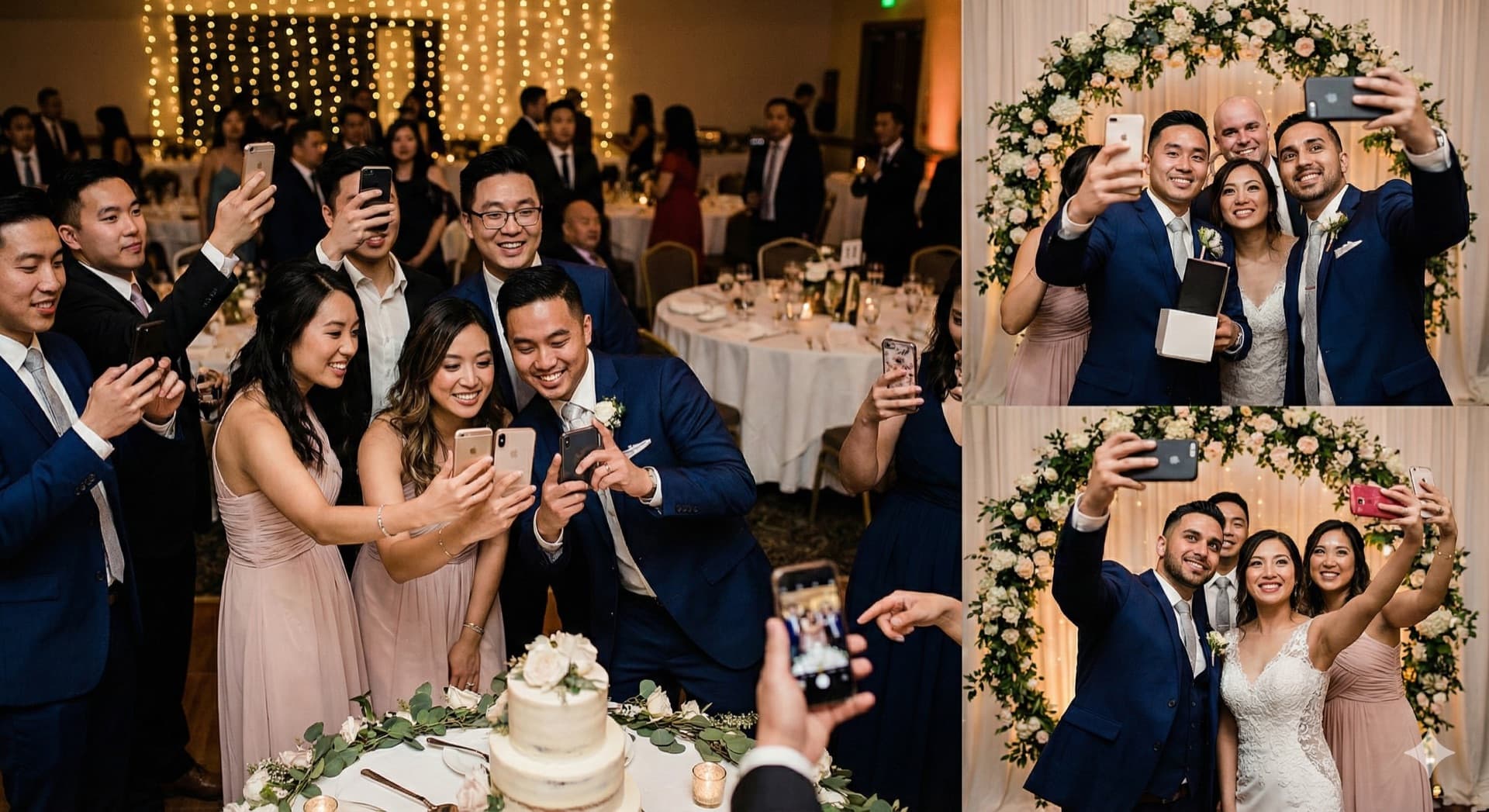
How to Collect Wedding Photos from Guests: 5 Methods Compared (2026)
The easiest way to collect wedding photos from guests is a QR code that opens an upload page in their phone browser. Here is how it compares with shared albums, group chats, hashtags and disposable cameras, and the three things that decide how many photos you actually get.

10 Ways Couples Lose Wedding Photos (And How to Prevent It)
Don't let precious memories disappear! Learn the most common ways couples lose wedding photos and simple solutions to protect them.

Where to Put Your Wedding QR Code: 10 Spots Ranked by Uploads (With Sizes)
Where you display your wedding QR code decides how many guest photos you collect. Ten placements ranked, with the size, wording and print tips for each: table cards, welcome sign, program, bar, live wall and five more.