The Complete Wedding Photo Checklist (72 Must-Have Shots)
The definitive wedding photo shot list — 72 must-have moments across getting ready, ceremony, portraits, reception, and details. Download and share with your photographer before the wedding.

Quick Answer
72 must-have wedding photos across 7 phases: getting ready (17 shots), ceremony (22), couple portraits (11), family formals (8), bridal party (6), reception details (8), and reception moments (7 — the list continues past 72 with bonus shots). Share the list with your photographer at the rehearsal dinner, assign a family member to wrangle groups, and pair it with a guest photo QR code to fill the gaps the professional photographer can't cover.
Why a wedding photo shot list matters
Your photographer is experienced and talented — but they can't read your mind. Without a shot list, they're making judgment calls all day about what matters to you. The result is usually great on the big moments and inconsistent on the personal ones: the handmade centerpiece your mother made, the flower girl's expression during the processional, the groom's face when he sees the bride. Those moments require a brief.
A shot list isn't about micromanaging your photographer. It's about a 15-minute conversation before the wedding that prevents a lifetime of "I wish we had a photo of that." This checklist covers 72 shots across every phase of the day — use it as a starting point, cross out what doesn't apply, add anything specific to your wedding, and hand it to your photographer at the rehearsal.
Getting Ready (17 shots)
The getting-ready phase is often rushed and undershot. These moments are casual, emotional, and gone fast. Assign a second shooter or ask your photographer to arrive 30 minutes before you expect to be ready — things always run early in the morning.
Bride getting ready:
- Wedding dress hanging in natural light (window or doorframe)
- Bride putting on or having dress buttoned/laced up — back detail, hands
- Bride putting on shoes — close-up
- Bride putting on jewelry — earrings, necklace, bracelet
- Bride looking in the mirror — full reflection
- Bride with mother: candid moment, helping with dress or veil
- Bride with bridesmaids: candid group moment (not a posed lineup)
- Bride with father: first look or moment before leaving — keep it real
- Bride alone, holding bouquet — window light portrait
- Flat lay of wedding details: invitation, rings, perfume, shoes, something blue
Groom getting ready: 11. Groom putting on jacket or tie — close-up hands 12. Groom with groomsmen: candid moment (not a lineup) 13. Groom with father or best man: handshake, hug, candid 14. Groom alone — clean portrait before the ceremony 15. Groom's accessories flat lay: boutonniere, cufflinks, watch, invitation
Both: 16. Gift exchange between bride and groom (if doing one) — shot of the gift and reaction 17. Letters being read — genuine reaction, not posed
Ceremony (22 shots)
The ceremony moves fast and doesn't stop for photography. Go through this list with your photographer and mark the moments you most care about — not every shot will be possible without a second shooter.
Processional: 18. Grandparents being escorted to seats 19. Parents being seated — emotional moments here 20. Flower girl and/or ring bearer walking the aisle (wide and close) 21. Bridesmaids walking the aisle 22. Groomsmen at the altar, waiting — candid 23. Groom's reaction when bride appears — shoot from the side to get both the groom's expression and the bride walking toward him. This is one of the most important shots of the day. 24. Bride walking the aisle with escort — wide shot from ahead, facing back 25. Father of the bride handing off the bride — the handshake or hug with the groom
Ceremony itself: 26. Wide venue shot showing full guest attendance 27. Officiant beginning the ceremony 28. Couple holding hands during vows — close-up 29. Couple reading vows — faces, genuine expression 30. Ring exchange — close-up of hands 31. First kiss — clean angle, no blocked sightlines 32. "You may kiss the bride" — officiant, couple, guests reacting 33. Guest reactions during ceremony: crying parents, laughing friends, children 34. Signing the marriage certificate (if accessible to photographer)
Recessional: 35. Couple walking back down the aisle, married 36. Guest reaction as couple passes — confetti, bubbles, rose petals if applicable 37. Couple stepping outside after ceremony — first moment alone
Couple Portraits (11 shots)
You'll have 45–60 minutes for portraits, usually split between family formals and couple shots. Use every minute of natural light — the hour after golden hour goes fast.
- Full-length portrait of couple together — venue in background
- Close-up portrait — faces together, candid or near-candid
- Candid walking shot — couple walking together, looking at each other
- Couple with venue architecture — staircase, doorway, arched entrance
- Detail shot: rings on both hands together
- Bride's dress from behind — train, buttons, full detail
- Bride bouquet close-up
- Groom boutonniere close-up
- Couple at golden hour or sunset — the "magic hour" shot
- Black and white conversion of a hero portrait (can be done in editing, but flag it)
- Candid laughing moment — these are often the favorite shots afterward
Family Formals (8 shots)
Keep the formal list short. More than 10–12 combinations takes 45+ minutes and tests everyone's patience. Prioritize the combinations that matter most and move on.
- Bride with both parents
- Bride with mother
- Bride with father
- Groom with both parents
- Groom with mother
- Groom with father
- Both families together (the big group shot)
- Immediate family only — both sides combined
Tip: Make a printed list of groupings with names and give it to a family member to corral people. Photographers lose 5–10 minutes per group calling names — this alone can save 20–30 minutes.
Bridal Party (6 shots)
- Full bridal party together — wide shot, venue background
- Bridesmaids only — candid or loosely posed
- Groomsmen only — candid or loosely posed
- Bride with each bridesmaid individually (flag if you want all of these vs. just MOH)
- Groom with each groomsman individually (same caveat)
- Bridal party candid — walking together, laughing, not posed
Reception Details (8 shots)
Detail shots are often the last priority and the first to get skipped. Ask your photographer to shoot venue details in the 30 minutes before guests enter — after that, tables fill up and shots are impossible.
- Full reception room — wide shot before guests enter
- Centerpiece close-up with venue in background
- Place settings: menu card, name card, tableware detail
- Wedding cake — full shot and close-up detail
- Sweetheart table
- Guest book and pen
- Bar setup detail
- Photo display, memory table, or other personal installation
Reception Moments (7 shots)
- First dance — wide, then close up for facial expressions
- Parent dances — father/daughter, mother/son
- Speeches: speaker at the mic, couple reacting, guests laughing or crying
- Cake cutting — close-up hands, then couple reaction
- Bouquet toss (if doing one)
- Guest candids on the dance floor — atmosphere shots
- Couple's last dance or grand exit (sparklers, petals, bubble tunnel)
How to use this checklist
Step 1: Go through the list and mark the 20–30 shots that matter most to you personally. Not every shot on this list is possible at every wedding — venues differ, schedules differ, and photographers have different styles.
Step 2: Add anything personal to your wedding that isn't on this list: a specific heirloom, a surprise element, an important guest, a venue feature.
Step 3: Share the final list with your photographer at the rehearsal dinner — not the morning of the wedding. Morning is too late to adjust plans.
Step 4: Assign a point person (usually the maid of honor or a family member) to help wrangle people for family formals. Tell them the groupings in advance.
Step 5: Let go. Once you've briefed your photographer, trust them. The shot list is a guide, not a script. The unplanned moments — the grandmother crying, the groomsman who drops the rings, the flower girl who sits down mid-aisle — are often the ones you'll frame.
Don't forget guest photos
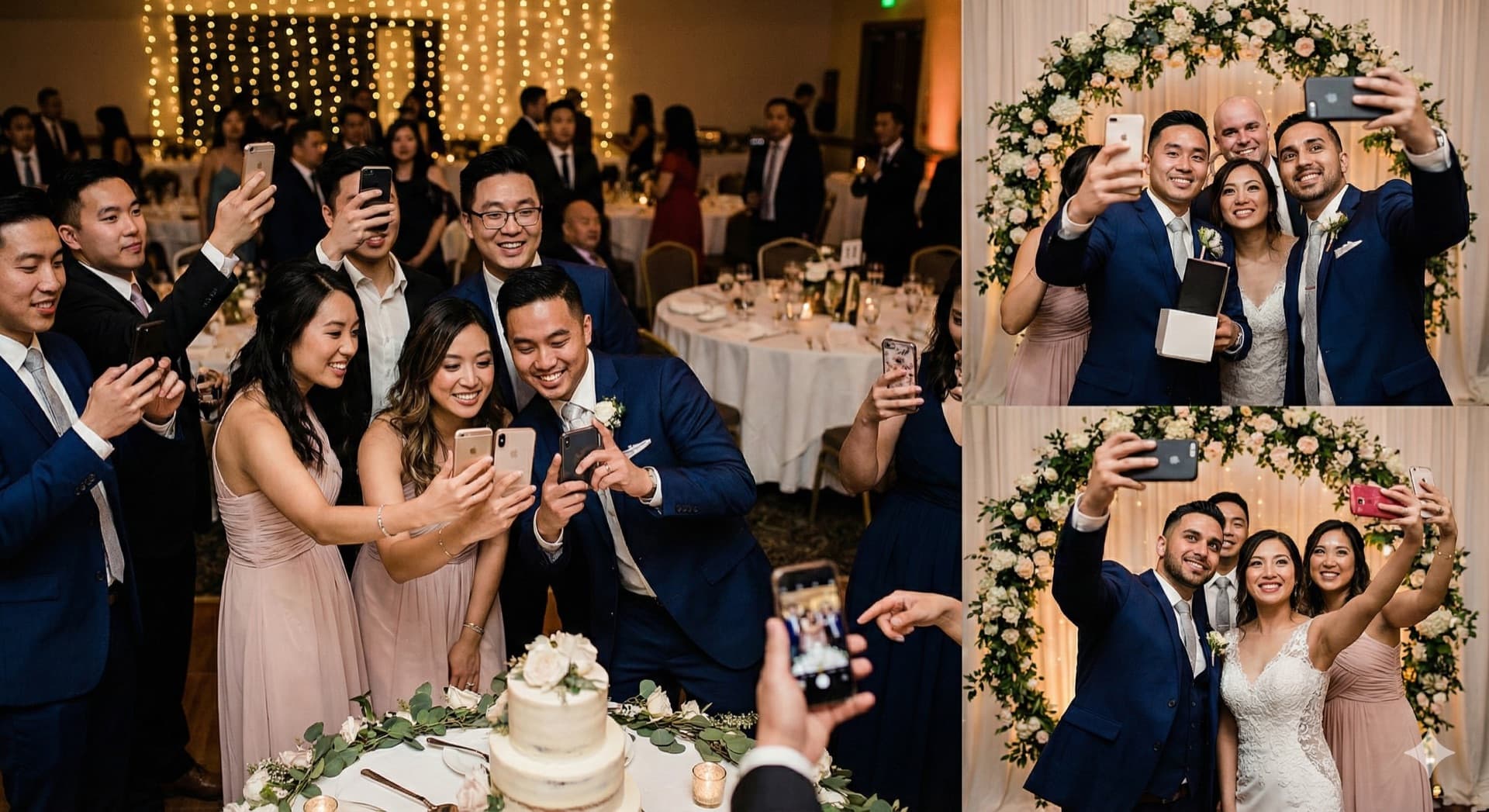
Your photographer covers the official story. Your guests capture the candid one: reaction shots from inside the pews during the ceremony, photos from the dance floor your photographer couldn't reach, moments from the getting-ready morning when the photographer was with the groom.
The easiest way to collect guest photos in original quality — without asking anyone to email you or download an app — is a QR code shared at the reception. Guests scan with their phone camera and upload through the browser in under 30 seconds. Couples using this system collect an average of 850 guest photos per wedding, delivered in original quality alongside the professional gallery.
Set up a free Snapeen event and have your QR code printed with your table cards. It takes 5 minutes and the photos will fill gaps in your professional gallery that no amount of planning would otherwise cover.
See also: How to collect wedding photos from guests · QR code for wedding photos: complete setup guide · Wedding photography trends 2026 · Best wedding photo apps 2026
Frequently Asked Questions
A professional wedding photographer typically delivers 400–800 edited photos for an 8-hour day, out of 2,000–4,000 shots taken. The ratio of delivered to taken depends on the photographer's style — documentary photographers shoot more and edit a smaller percentage; posed photographers shoot fewer but deliver a higher percentage. For 72 must-have shots, the realistic expectation is that all will be delivered, but the quality and candor of each depends heavily on timing and preparation.
A second shooter is worth the extra cost ($200–500 typically) for weddings over 100 guests or any wedding where the groom's and bride's getting-ready moments are happening at the same time in different locations. A second shooter also covers guest reaction shots during the ceremony that the main photographer physically cannot capture while shooting the couple. For smaller or simpler weddings, a single experienced photographer can cover the 72-shot checklist.
Share your finalized shot list at the rehearsal dinner — not the morning of the wedding. The morning is too late to adjust plans, assign a second shooter to specific moments, or change the schedule. Give your photographer at least 48 hours to review it, ask questions, and flag any shots that might be difficult given your venue or timeline.
The most commonly missed shots are: (1) the groom's reaction when the bride walks in — most photographers position themselves with the bride and miss the groom's face; (2) candid moments with grandparents; (3) reception detail shots taken before guests enter — once tables fill, many detail shots become impossible; and (4) guest candids on the dance floor. A second shooter addresses most of these simultaneously.
Topics

Written by
Emily Chen
Helping couples and event planners capture every precious moment with modern QR code photo sharing technology.
Ready to collect your event photos?
Set up your QR code in 2 minutes. Guests scan and upload instantly — no app needed.
Continue Reading
Related Articles
How to Collect Wedding Photos from Guests (Complete 2026 Guide)
The easiest way to collect wedding photos from guests is a QR code — no app needed, 500–1,200 photos in 24 hours. Here's exactly how to set it up, where to display it, and what to do with everything afterward.

10 Ways Couples Lose Wedding Photos (And How to Prevent It)
Don't let precious memories disappear! Learn the most common ways couples lose wedding photos and simple solutions to protect them.

10 Creative Ways to Display a QR Code at Your Wedding (More Uploads)
Where you display your wedding QR code determines how many guest photos you collect. Data from 1,000+ weddings shows which placements drive the most uploads — table cards, bar areas, live slideshows, and 7 more.